
One Patient. Two Programs. Both Billable.
Most practices run chronic care management or remote monitoring. Running both on the same patient, in the same month, without double-counting a single minute is where the model compounds.
Why Combine
Two Halves of the Same Problem
RPM tells you what is happening: a blood pressure trending upward across nine days, a four-pound weight gain in seventy-two hours, glucose drifting out of range every afternoon.
CCM is what someone does about it. The phone call, the medication reconciliation, the care plan revision, the escalation to your office before the patient ends up in an emergency department.
Devices without coordination produce dashboards nobody acts on. Coordination without devices produces a monthly call built on what the patient happens to remember. Run together, each one makes the other work.
The Core Rule
Yes, You Can Bill Both. Here Is the One Rule.
CMS permits chronic care management and remote physiologic monitoring to be billed for the same patient in the same calendar month. There is one condition, and it is absolute:
The same minute cannot be counted toward both programs. Twenty minutes of CCM time and twenty minutes of RPM time must be forty distinct minutes of work.
This is where in-house combined programs fail review. A coordinator takes a twenty-five minute call covering medication adherence and blood pressure readings, then logs the full call against both codes. That is a duplicate claim, and it is the first pattern a reviewer looks for because it is the easiest to find.
How CareNexa enforces separation
Timers start before the work does. The coordinator selects CCM or RPM before opening the encounter. Time cannot be reassigned afterwards.
Mixed calls are split explicitly. Where one conversation covers both domains, the coordinator divides it at documentation: twelve minutes CCM, thirteen minutes RPM, with a separate narrative on each side. One call, two logs, zero overlap.
The platform blocks the overlap. Concurrent timers cannot run against the same patient. A minute claimed by one program is unavailable to the other.
Monthly reconciliation before submission. Both time ledgers are reviewed before claims go out. Any patient whose totals look mechanically identical across programs is pulled for manual review.
When an auditor asks how you keep the two apart, “we are careful about it” is not an answer. A timestamped, program-tagged, split-at-entry ledger is.

Code Stacking
What Stacks, and What Does Not
The two families run on separate tracks. Nothing in the CCM column competes with anything in the RPM column; they are billed for different work, measured on different clocks.
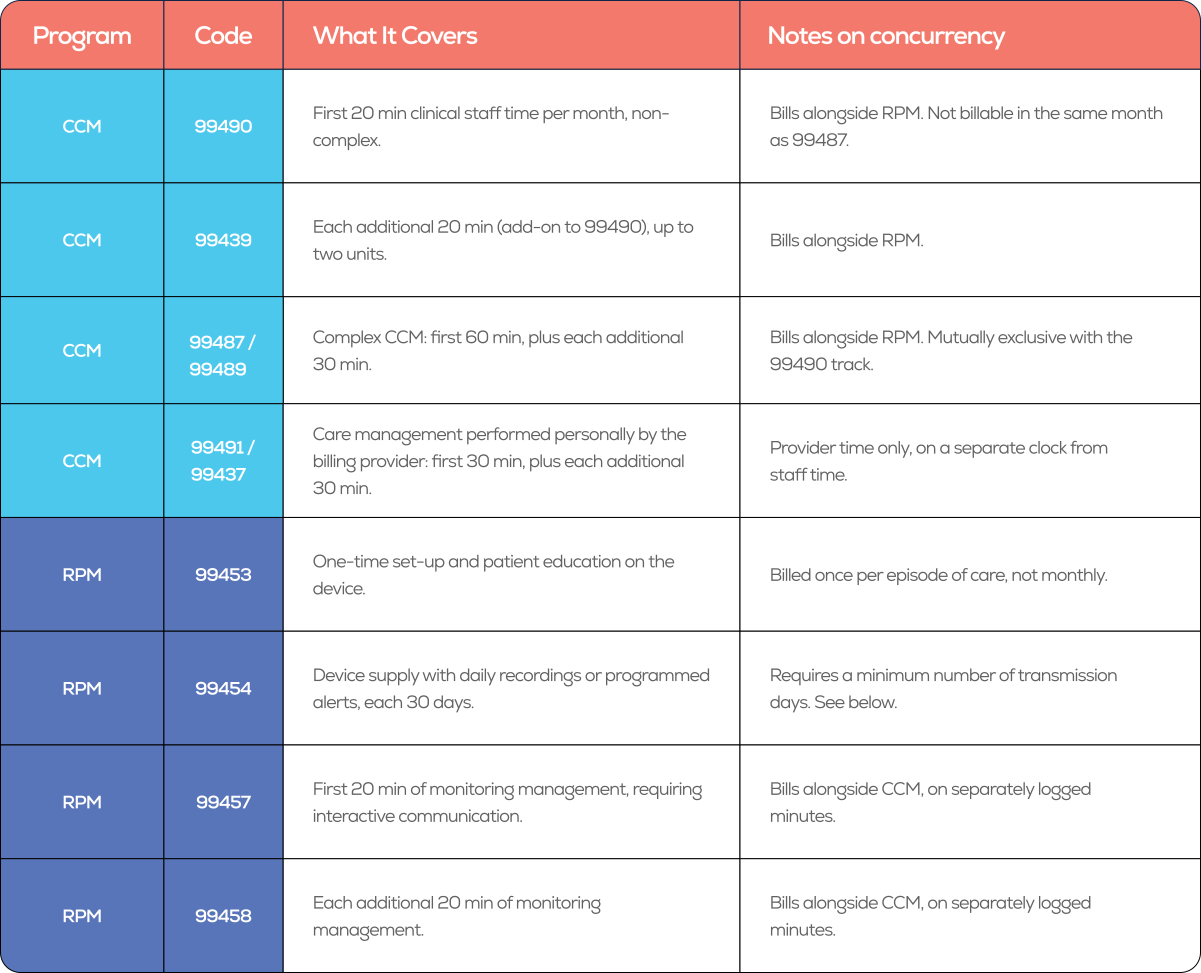
Two constraints that surprise practices:
Only one practitioner may bill remote monitoring for a given patient in each period, and 99091 is generally not billed for the same period as 99457. If a specialist is already monitoring your shared patient, that patient is not available to your program. We check this at enrollment rather than discovering it in a denial.
Practices billing under an RHC or FQHC benefit report care management differently, under the general care management code rather than the individual CPT codes above. The program still works; the billing mechanics differ. Ask us.
Patient selection
Which of Your Patients Actually Belong on Both
The combined program is not an upsell applied to your whole CCM panel. It fits a specific profile and applying it more widely than that produces device costs, adherence failures and audit exposure without clinical benefit.
Strong candidates
- Two or more chronic conditions expected to last twelve months or longer, the CCM threshold is where at least one condition has a physiologic marker genuinely worth measuring between visits.
- Heart failure with hypertension: daily weight and blood pressure are the two measurements most likely to catch decompensation early.
- Type 2 diabetes with hypertension: the highest-volume combined profile in most primary care panels.
- COPD with cardiovascular comorbidity, where pulse oximetry adds a signal, a monthly call cannot.
- Recently titrated medication regimens, where between-visit data changes the next clinical decision.
- Patients with a history of avoidable admissions and a caregiver able to support the routine.
Patients we will tell you to leave out
- Chronic conditions with nothing meaningful to measure daily, stable hypothyroidism alongside osteoarthritis qualifies for CCM and gains nothing from a device
- Patients whose readings would not change management, however diligently they are taken.
- Patients already monitored remotely by another practitioner.
- Patients with no realistic path to sustained daily readings and no caregiver support .
Questions Practices Ask About the Combined Program
Is billing both programs in the same month genuinely allowed, or is it a grey area?
It is explicitly permitted, and it is not a grey area provided the time is separately logged and never counted twice. The risk in a combined program is not the concept; it is sloppy time attribution. That is an operational problem, and it is solved with tooling and process rather than caution.
Does the patient pay twice?
They are two separate services with two separate sets of work behind them, so where the patient’s coverage imposes cost sharing, it can apply to each. It is not a second charge for the same work. What matters more is that the patient hears this at enrollment rather than reading it on a statement, so we say it plainly before they consent. Where the combined amount is a genuine barrier for a patient, we would rather enroll them in the one program that helps most than lose them from both in month three.
What if a patient only sustains one of the two programs?
That is a normal outcome rather than a failure, and it is usually the device that lapses while the monthly call continues. The patient stays on care management, monitoring billing stops, and we tell you rather than carrying a program that is no longer producing readings. Where it runs the other way, the readings arrive reliably but the call keeps getting missed, we look first at whether we are calling the wrong person at the wrong time before concluding the patient is not interested.
Can we start with one program and add the other later?
Yes, and it is frequently the better sequence. Starting with care management lets you see which patients have a marker genuinely worth measuring before a device goes into anyone’s house. Starting with monitoring makes sense where the panel is dominated by heart failure or uncontrolled hypertension and the measurement is obvious. Adding the second program later needs consent for that program and a fresh eligibility check, both of which we handle. There is no second onboarding.
How do we know the time separation would hold up under review?
Because the separation lives in the record rather than in a policy. Timers are tagged to a program before the encounter opens and cannot be reassigned afterwards, mixed calls are split at documentation with a separate narrative on each side, concurrent timers against the same patient are blocked, and both ledgers are reconciled before claims go out. What you can hand a reviewer is a timestamped, program tagged log showing which minutes belonged to which program and what was done in them. You can pull that export at any time, not just when somebody asks for it.
Who owns the patient relationship?
You do, without qualification. Coordinators identify themselves as calling on behalf of your practice, work from the care plan you approved and escalate to your clinicians. We do not market to your patients, we do not contact them about anything outside the program, and if you end the agreement the relationship and the records stay with you.
What happens to the device if a patient leaves the program?
We arrange the return and we cover it. The device was never your asset, so there is nothing for the practice to reclaim, write off or store, and an unreturned device is our loss rather than yours. This is the practical half of no device cost, and it is the half most practices only think to ask about after they have signed with somebody else.
Find Out How Much of Your Panel Qualifies for Both
Many patients who qualify for CCM also qualify for RPM and vice versa. Running both programs on the same patient means coordination time and monitoring time are tracked and billed separately, through one clinical team and one dashboard, instead of running two disconnected programs.